Architecture diagrams
Nine diagrams generated from Mermaid sources. Click any diagram to open it full size.
Fig 1 — Ecosystem context
Where the aggregator sits: ABHA gives identity and addressability (not storage); the HIE-CM and Gateway carry consent and routing; HIPs push encrypted FHIR R4 bundles to the aggregator; devices and documents are direct channels; NHCX is participant-only (PAYER / PROVIDER / TPA), so consumer insurance data comes from documents and partnerships.

Fig 2 — Logical architecture
Six layers: channels → edge & policy enforcement (every call passes the consent × purpose policy engine) → acquisition services → normalisation (FHIR ⇄ Health Graph with provenance and trust tier) → intelligence & experience services → India-region data plane with per-person keys.

Fig 3 — ABDM consent and data flow
Asynchronous self-access sequence: discovery & linking, consent request (accessMode, dateRange, dataEraseAt, frequency), approval in the PHR/ABHA app, consent-notify callback, artefact fetch, health-information request with a fresh X25519 key pair, encrypted push, ECDH→HKDF→AES-GCM decrypt, validation, canonicalisation; revocation path at the end.
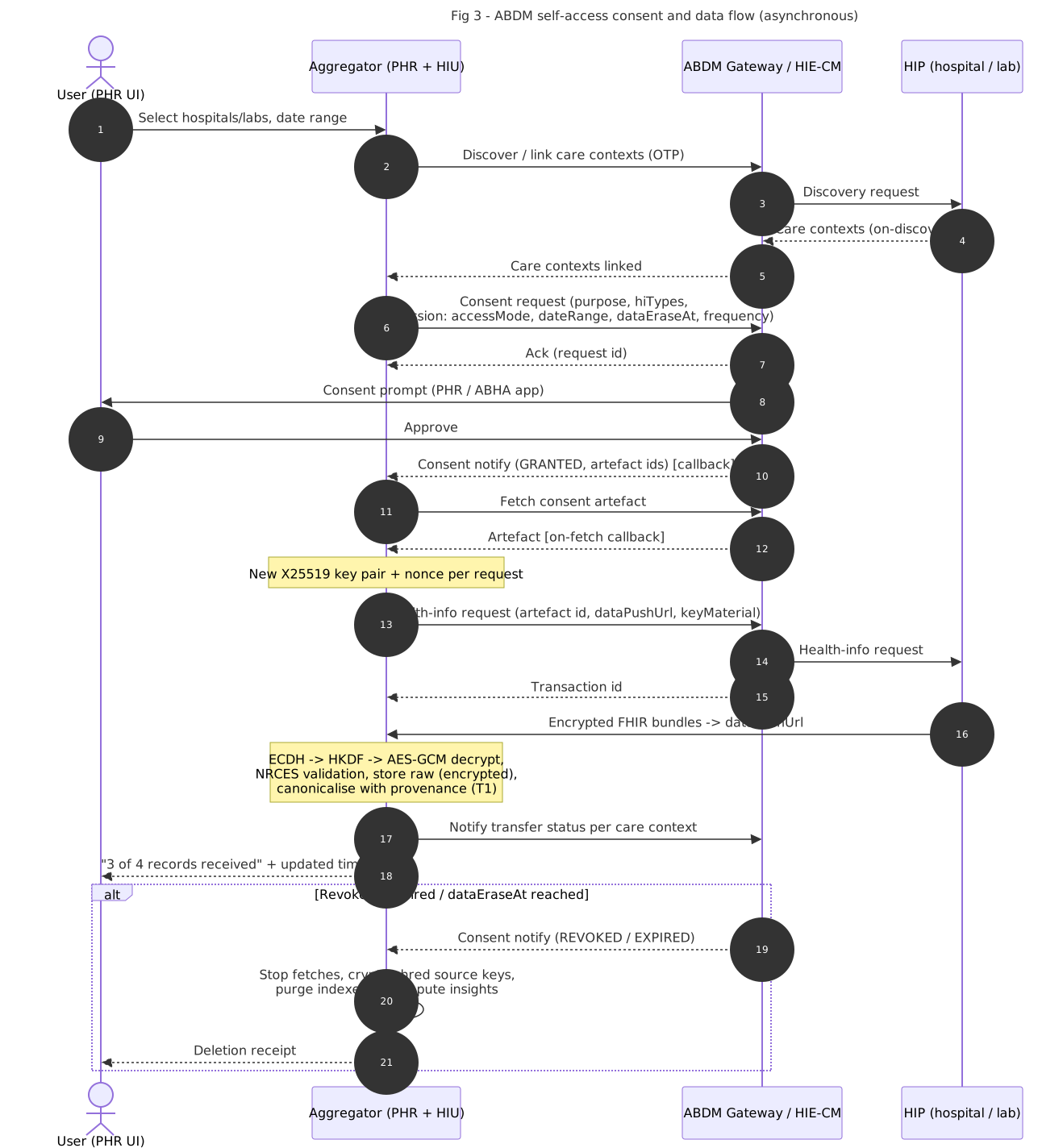
Fig 4 — Document AI pipeline
Intake (upload, camera, WhatsApp, email) → pre-processing → OCR → classification → family-member match → extraction → normalisation (LOINC/SNOMED/ICD/UCUM, brand→molecule) → confidence routing with mandatory confirmation for handwritten medicines.

Fig 5 — Consent lifecycle
One state model for ABDM artefacts and platform purposes; withdrawal or expiry triggers crypto-shredding, index purge, insight recomputation and a deletion receipt.

Fig 6a — Health Graph: clinical entities
Identity, family and clinical entities. Every node also carries a provenance envelope (source, raw reference, consent IDs, ABDM transaction, confidence, verification, retention).

Fig 6b — Health Graph: insurance, consent, provenance
Policies with clause-referenced coverage, exclusions and waiting periods; claims linked to encounters and expenses; Coverage-to-Care link; consents authorising the source artefacts.

Fig 7 — Security zones
Classification-based zones (C4 restricted under per-person KMS keys, C3 clinical, C1 de-identified analytics), SOC with CERT-In 6-hour reporting, no standing workforce access to C4 data.

Fig 8 — Capability roadmap
Legal opinions, DPIA and clinical safety case gate the MVP; four pilot measures gate Phase 2; Phase 3 adds provider SaaS/NHCX, UHI booking and regulated insurance journeys only if licensed.
